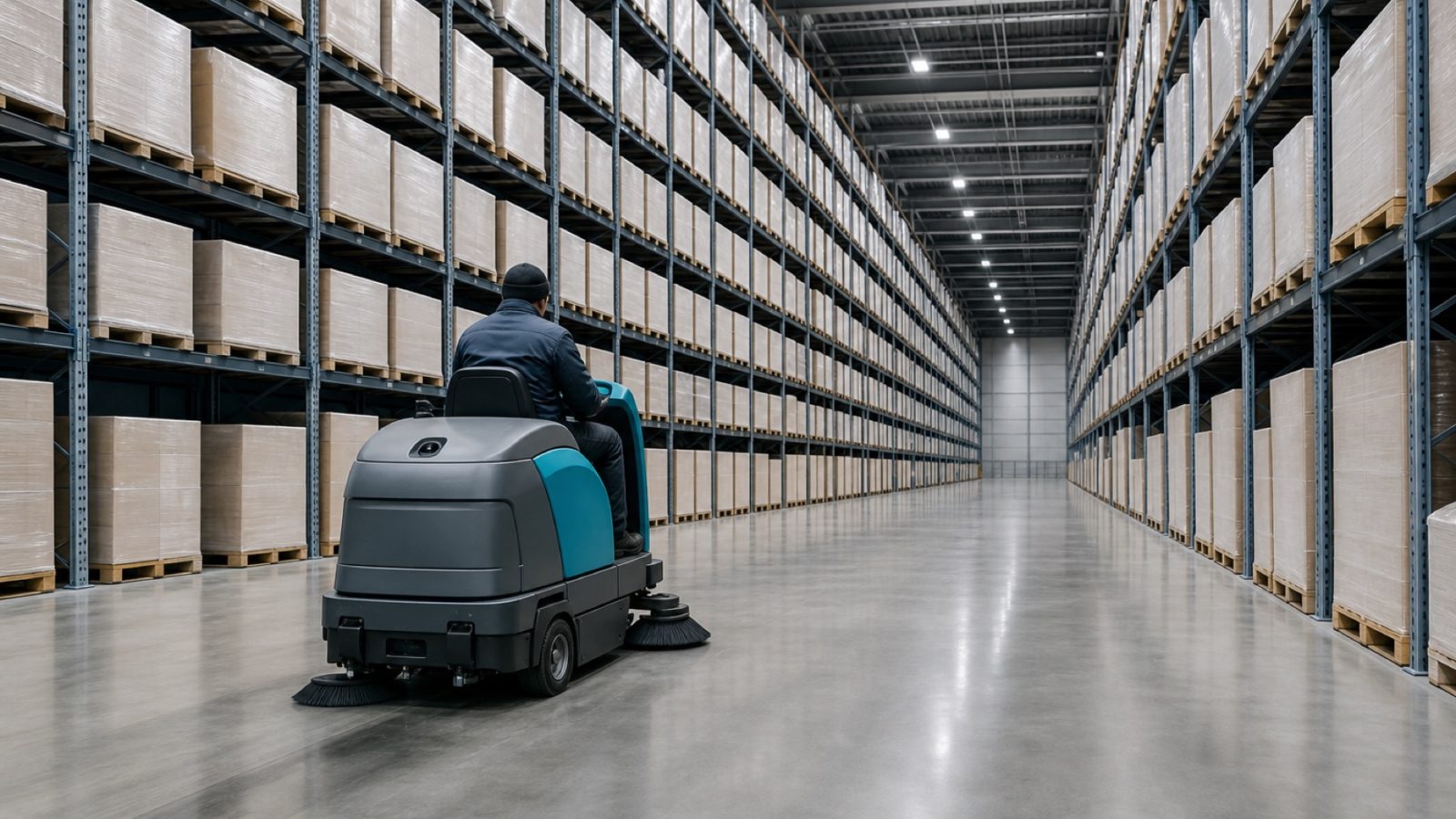
Almost every scrubber dryer is advertised with a productivity figure in square metres per hour. On most datasheets that number is theoretical: deck width multiplied by travel speed, with nothing subtracted. A 750 mm deck at 6 km/h gives 4,500 m²/h. No machine has ever cleaned 4,500 square metres in an hour.
What the gap is made of
Four things take the theoretical figure down to a practical one.
Overlap. Passes have to overlap or you leave dirty stripes. In practice operators overlap by 5 to 10 per cent, and more on a floor with no visual reference lines.
Turns. At the end of every run the machine slows, turns and accelerates. In a long distribution centre aisle that costs little. In a 15 metre room it can be a quarter of the working time.
Obstacles. Racking legs, pallets, doorways, floor drains, ramps. Every one is a slow-down, and dense obstacles hurt a wide deck far more than a narrow one. This is the single most common reason a ride-on underperforms a walk-behind on a congested floor.
Filling and emptying. Tank capacity divided by solution flow gives the run time between fills. Add the walk to the fill point, the fill itself, the recovery tank dump and the walk back. On a machine with a small tank this can be 20 per cent of the shift.
A working estimate
For a large open floor with few obstacles, expect 60 to 70 per cent of the theoretical figure. For a mixed floor with aisles and racking, 50 to 60 per cent. For congested retail or a hospital corridor with furniture and people, 40 to 50 per cent is realistic, and the wide deck that looked best on paper may finish behind a narrower machine that never has to stop.
How to check it before you buy
Take one representative section of your floor, ideally 500 to 1,000 square metres including its share of turns and obstacles. Clean it properly with the machine you are considering, timed, including one refill. Scale that up. The number you get is worth more than any datasheet, and it is the number to build the cleaning plan on.
Where the plan usually goes wrong
Two mistakes account for most of the disappointment. The first is planning against a theoretical figure and then blaming the operator when the shift overruns. The second is buying the widest deck that fits through the door, on the assumption that width and output are the same thing. On a congested floor they are not: a 750 mm machine that has to stop and reverse at every rack leg will finish behind a 530 mm machine that keeps moving.
Ask any supplier for both figures. A supplier who will only quote the theoretical one is telling you something about how the machine will perform on your floor.